Amex Stadium — Brighton & Hove Albion
Tucked into the South Downs at Falmer, the Amex is modern done right — compact, loud, and earned after decades of groundsharing misery. Worth the trip.
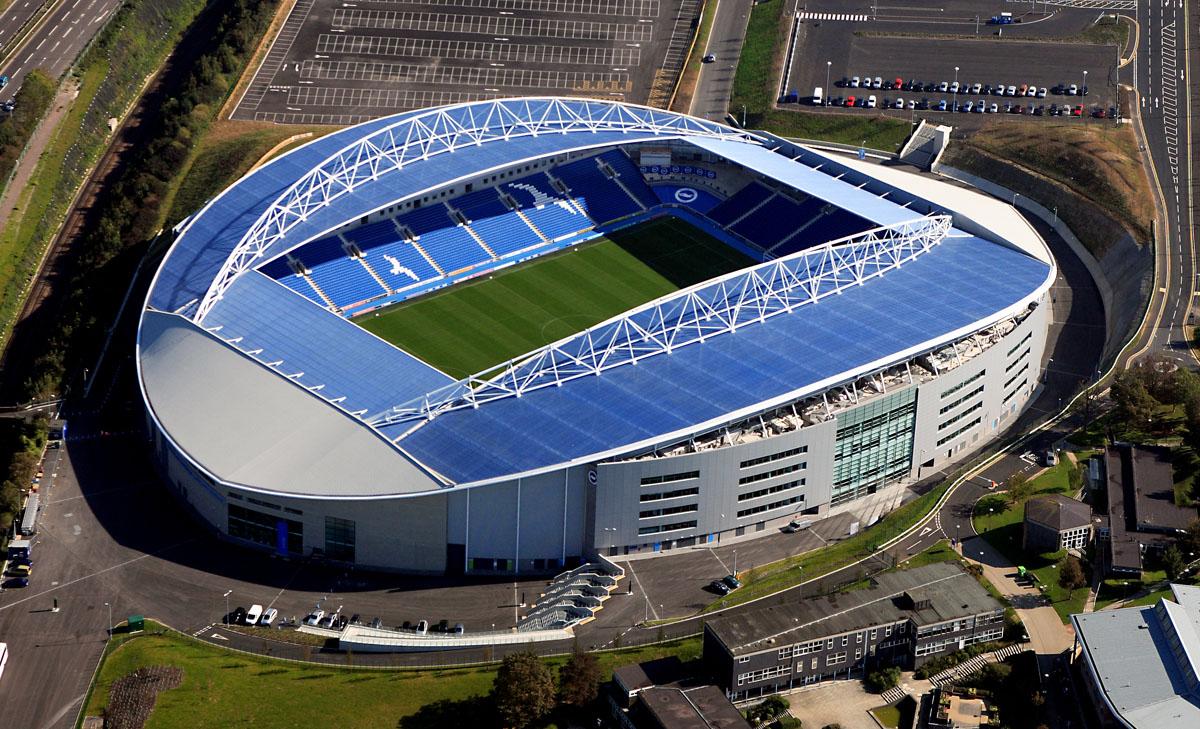
There are modern grounds built because a club wanted a bigger car park and a corporate hospitality suite named after a local estate agent, and then there are modern grounds built because a club genuinely needed one. The Amex is the latter. Brighton spent the best part of two decades groundsharing, ground-hunting, and ground-losing before they finally got here in 2011, and that backstory matters — it gives this place a weight that most grounds of its age simply don't carry. Come for the football, stay for the view of the Downs.
The Place That Made Them
Brighton & Hove Albion sit in one of the most unusual footballing contexts in the country. They are the only professional club in a city of nearly 400,000 people, perched on the south coast with no serious local rival within easy reach, surrounded by a fanbase that is as eclectic as the city itself. Brighton is not a traditional football town in the way Burnley or Grimsby is — it is a city of students, artists, day-trippers, and long-term residents who have made it their own — and yet the club has always had a fierce, genuine support. The Amex sits not in Brighton proper but in the village of Falmer, just inside the South Downs National Park, which tells you something about how hard it was to find a site that would get planning permission. The setting is genuinely beautiful, which is not something you say about many Premier League grounds.
First Impressions
The approach from Falmer station is short and slightly surreal — you come over a rise and the ground appears almost suddenly, its curved white roof catching the light against the green of the Downs behind it. The design by KSS is one of the better pieces of football architecture from the last fifteen years: a continuous bowl with a low, sweeping roof that keeps the noise in without making the place feel like a bunker. The four stands — North, South, East, and West — are all covered, all close to the pitch, and the sightlines from almost every seat are excellent. The floodlights are integrated into the roof structure rather than standing as separate pylons, which gives the whole thing a clean, considered look. It holds just over 30,000, which feels about right — big enough to generate real noise, small enough that you never feel lost in it. Locals call it the Amex, occasionally the American Express Stadium when they're being formal, and that's what it's been since it opened. There's no complicated naming history to unpick here.
Away Day Reality
Away fans are housed in the upper and lower tiers of the North Stand, which is a decent allocation in terms of numbers and not a bad place to watch a match. The view is fine — you're behind the goal, covered, with a clear sightline to the far end. The lower tier can feel a little flat if the away following is thin, but pack it out and it generates reasonable noise. The concourses are functional and modern without being particularly characterful. Brighton supporters are generally a good-natured lot — you're unlikely to have any bother, even on a feisty matchday. The one honest caveat is that the away end, like much of the ground, is comfortable rather than atmospheric in the old-fashioned sense. It does the job well. It just doesn't have the creak and lean of somewhere that's been there since 1902.
The Walk In
Falmer station is the one to aim for — it's four minutes from the turnstiles on foot, and trains run directly from Brighton station, which is about twelve minutes down the line. From Brighton itself you're looking at a roughly seventy-minute walk, so don't attempt it unless you've got time to kill and good shoes. The station gets busy after the match, but Southern Rail usually lays on extra services and the queues move. Driving is possible but the parking situation around Falmer is restricted and the roads back towards Brighton can be slow — the train is genuinely the better option here, and it's one of the easier Premier League grounds to reach without a car. The walk from Falmer station takes you past the University of Sussex campus, which gives the whole approach a slightly campus-festival feel on a sunny afternoon.
The Arc
The story of Brighton & Hove Albion is essentially a story about survival and vindication. They left the Goldstone Ground in 1997 under circumstances that still make supporters' blood boil — sold off by a chairman widely regarded as one of the most destructive figures in English football — and spent eight years groundsharing at Gillingham and then Withdean, an athletics track that was never designed for football and never pretended otherwise. The club nearly dropped out of the Football League entirely. What followed was a slow, determined rebuild: Tony Bloom taking over, Paul Barber running the operation properly, a succession of good managers culminating in Graham Potter and then Roberto De Zerbi turning them into a genuine top-half Premier League side capable of European football. The Amex is the physical proof that it worked. Every time you sit in it, you're sitting in the answer to a question that once looked like it might have a very different ending.
Before and After
Options immediately around the ground are limited by the rural setting, but there are a couple worth knowing about. The Swan Inn on Middle Street in Falmer village is a short walk from the ground and has a solid rating — a proper village pub that gets busy on matchdays. The Falmer Bar over at Falmer House on the University of Sussex campus is another option nearby, a student union bar that tends to be relaxed and reasonably priced. Neither pub has a confirmed away-friendly policy on record, so use your judgement on a big fixture day and keep the colours low-key if you're unsure of the temperature.
- The Swan Inn (Middle St, Falmer, Brighton BN1 9PD) — a traditional village pub a short walk from the ground, well-rated and a natural pre-match gathering point.
- Falmer Bar (Falmer House, University of Sussex, Falmer BN1 9QF) — the university bar on campus, relaxed atmosphere and worth knowing about if the Swan is rammed.
Inside the ground, the concourse food is standard modern-stadium fare — better than it used to be at most places, not quite a revelation. The programme is well-produced if you're a collector. The North Stand lower tier is where the noise tends to gather on a big night, and when Brighton are flying and the Downs are dark behind the floodlights, this is a genuinely good place to watch football.
Track every ground you visit
Log your visits, discover new grounds nearby, and see your groundcount grow.
| Download on the App Store | Get it on Google Play |