Villa Park — Aston Villa
Over 42,000 seats, a Trinity Road stand that turns heads, and a Holte End that still knows how to make itself heard. Villa Park earns its reputation.
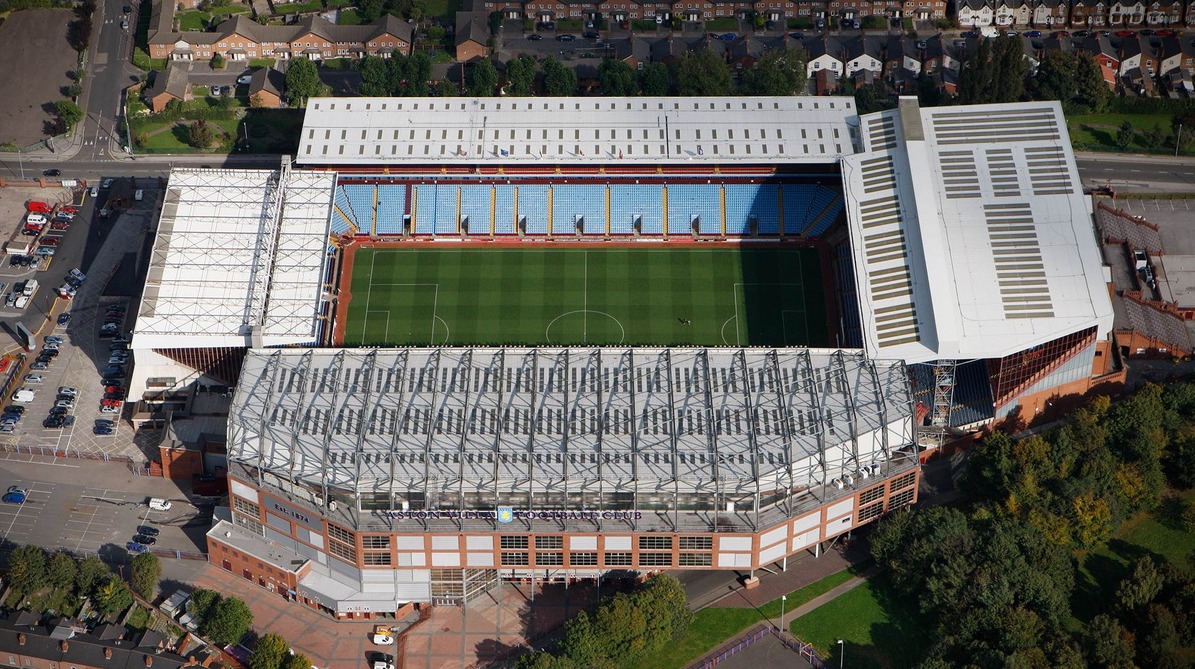
There are grounds that impress you on paper and disappoint in person, and then there is Villa Park — a place that does the opposite. You arrive expecting something grand and it still manages to surprise you, not with novelty but with the kind of accumulated weight that only comes from a ground that has been doing this since 1897. This is one of the great English football grounds, and the argument for visiting it is simple: you should see it at least once, and once is rarely enough.
A Club Shaped by Its Place
Aston is a dense, working-class district sitting just north of Birmingham city centre, hemmed in by the Aston Expressway and the kind of terraced streets that have been sending men to football matches for well over a century. Villa are not a suburban club that happened to grow big — they are a Birmingham institution, formed in 1874 by members of the Villa Cross Wesleyan Chapel, rooted in this specific patch of the city long before the Premier League existed or anyone thought to call football a product. In a city that also houses Birmingham City, the identity is fiercely distinct: Villa are the claret and blue, the European Cup winners, the club that considers itself the senior partner in this city's football conversation. Whether you agree with that or not rather depends on which side of the Aston Expressway you were born.
First Impressions
The approach along Trinity Road gives you the ground in stages, and the Trinity Road Stand itself — the old main stand, now the North Stand on that side — is the first thing that stops you in your tracks. The exterior facade along Trinity Road is genuinely beautiful: red brick, ornate detailing, the kind of architecture that reminds you football grounds were once built to make a statement about civic pride rather than corporate hospitality. Inside, the scale hits you properly. Four substantial stands enclose the pitch tightly enough to generate real noise: the Holte End to the south, the Doug Ellis Stand to the east, the North Stand along Trinity Road, and the Witton Lane Stand opposite. The floodlight pylons are the old-fashioned tall-mast variety, four of them rising above the corners, and they suit the ground entirely — modern uprights would look wrong here. The pitch is a proper 105 by 68 metres, well-maintained grass, and the sight lines from most of the ground are excellent. The Holte End, which once held 20,000 standing supporters on its vast terrace, is now all-seated but still the spiritual heart of the place — when it gets going, you feel it in your chest.
For the Travelling Support
Away fans are housed in the lower tier of the Doug Ellis Stand, in the north-east corner of the ground. It is a covered allocation, the view is decent, and the acoustics in that corner are good enough that a vocal away following can make themselves heard. The upper tier above is sometimes opened for larger allocations, which gives you a higher vantage point and an even better view of the pitch. What you will not get is any sense of being particularly welcomed by the home support — Villa fans are not hostile in the way some grounds can be, but they are not especially warm either. It is a professional indifference, which is fine. The away end is functional, well-positioned, and gives you a proper view of the Holte End in full voice, which is worth the trip on its own.
The Journey In
Witton station is your friend here. It sits on the Cross-City line and drops you five minutes' walk from the ground — follow the crowd up Witton Road and you cannot go wrong. From Birmingham New Street, you are looking at a straightforward train journey of around ten minutes. Aston station is also on the network and puts you about thirteen minutes on foot from the turnstiles, which is a perfectly pleasant walk through the back streets if you want to approach from a different angle. Driving is possible but the surrounding streets fill up quickly and the Aston Expressway is not forgiving on matchday. The train is the right answer here, and the frequency of services on the Cross-City line means you are not stranded after the final whistle.
Their Story
The arc of Aston Villa's history is one of English football's most dramatic. Seven league titles, seven FA Cups, and then — the thing that still defines them in the minds of a generation — the European Cup in 1982, won in Rotterdam against Bayern Munich with a goal from Peter Withe that the club has been dining out on ever since, quite rightly. What followed was a long, painful decline: relegation from the top flight in 2016, a near-miss with administration, a return via the play-offs in 2019, and then a slow, expensive reconstruction under new ownership that has brought them back to European competition. The story of Villa in the modern era is one of a club that genuinely fell apart and has been painstakingly put back together — and the ground, which never really declined in the way the club did, has been waiting patiently for the team to catch up with it.
Pubs, Pies & Matchday
The pub options around Villa Park are concentrated along Witton Road and the surrounding streets, and the atmosphere on matchday is lively without being intimidating. Since away-friendly status is unconfirmed for all the nearby options, away supporters are advised to use their judgement and keep colours discreet in the immediate vicinity of the ground — this is a big-city derby-capable crowd and the mood can shift depending on the fixture.
- Bar 1874 (Birmingham B6 6HD, approx. 45 metres from the ground) — a club-adjacent bar right on the doorstep of Villa Park; worth knowing about if you are in the area early.
- The Holte Pub (Villa Park, Trinity Rd, Birmingham B6 6HE, approx. 250 metres) — sits in the shadow of the ground itself and draws a heavy home crowd on matchday; rated well by those who use it.
- Witton Arms (458 Witton Rd, Birmingham B6 6SN, approx. 370 metres) — a traditional pub on Witton Road, well-rated and conveniently placed on the walk from Witton station.
- The Aston Tavern (10 Aston Hall Rd, Birmingham B6 7FF, approx. 510 metres) — a well-regarded local with a solid Google rating; slightly further out but worth the extra few minutes if you want something a touch quieter.
- The Sacred Heart Club (28 Grange Rd, Aston, Birmingham B6 6LA, approx. 645 metres) — the highest-rated option in the immediate area; a members' club by the look of it, so worth checking access before you make the walk.
- The Yew Tree (Brookvale Rd, Birmingham B6 7AS, approx. 820 metres) — the furthest of the nearby options but well-rated and likely to be less heaving than the pubs right on the ground's doorstep.
Inside the ground, the catering is what you would expect from a Premier League operation — pricier than it should be, but the pies are a cut above the average. The matchday programme is a proper production, worth picking up if you collect them. And when the Holte End finds its voice — really finds it, on a big European night or a tight derby — Villa Park reminds you exactly why some grounds are worth travelling a long way to see.
Track every ground you visit
Log your visits, discover new grounds nearby, and see your groundcount grow.
| Download on the App Store | Get it on Google Play |