The Hawthorns — West Bromwich Albion
The highest ground in the Football League, sitting proud on the Birmingham plateau. The Hawthorns is old Black Country football at its most uncompromising.
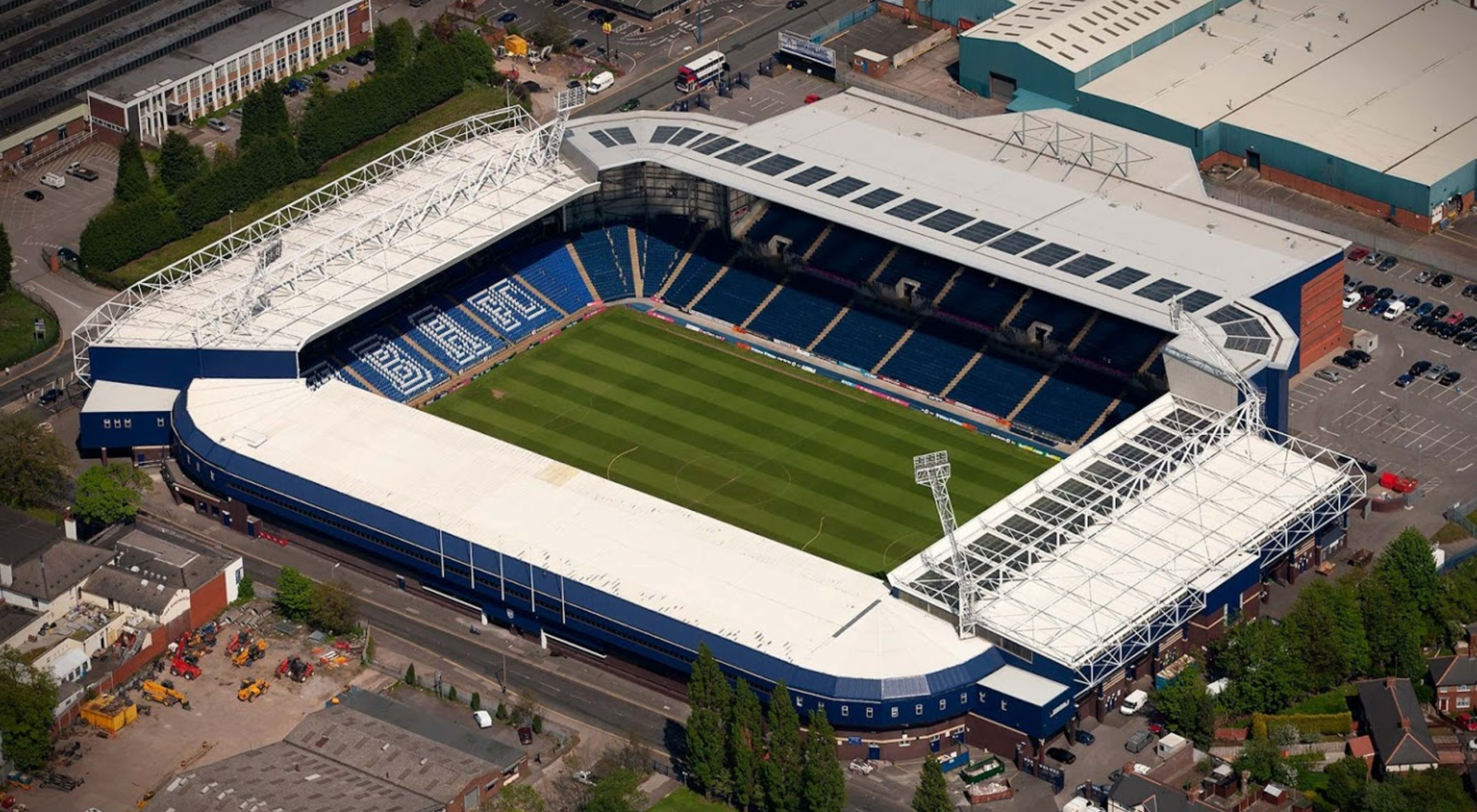
The Hawthorns sits at roughly 551 feet above sea level — the highest ground in the Football League, a fact Albion supporters will tell you before you've even asked. That elevation is not just a pub quiz answer; it tells you something about the place. This is a ground that doesn't apologise for itself, doesn't dress itself up, and doesn't need to. It has been here since 1900, it has seen top-flight football and Championship graft in roughly equal measure, and it carries both with the same straight-backed indifference to your opinion of it.
Where They Come From
West Bromwich is not Birmingham, and the people here will make sure you know it. The town sits in the heart of the Black Country — that dense, post-industrial stretch of the West Midlands that produced more metal, more nails, more chains and more anchors than anywhere else on earth, and produced football clubs with a similar toughness. Albion are surrounded on all sides by rivals: Villa to the east, Wolves to the west, Birmingham City to the south, and the Baggies have always defined themselves partly in opposition to all of them. There's a working-class pride here that runs deeper than football, and the club is the vessel for it. When Albion are up, the whole town feels it. When they're down — and they've been down — the town feels that too.
Four Sides
The Hawthorns is a proper Football League ground in the best sense: four distinct stands, each with its own character, none of them quite matching the others. The East Stand — the main stand — runs along Halfords Lane and is the oldest-feeling part of the ground, with that slightly cramped, close-to-the-pitch quality that modern arenas have engineered out of existence. The Smethwick End behind the south goal is the traditional home end, low-roofed and loud when it wants to be. The Birmingham Road End to the north is the larger covered terrace end, and the West Stand completes the rectangle with a more modern feel. The floodlights are proper old-school pylons at each corner, the kind that cast that particular orange glow over a midweek fixture that makes you feel like you're watching football the way it was meant to be watched. The pitch itself sits slightly below the surrounding streets, which gives the whole place a sunken, enclosed quality once you're inside — the noise stays in, the wind mostly doesn't.
For the Travelling Support
Away fans are housed in the upper tier of the East Stand, which is a better deal than it sounds. The view is genuinely good — you're high enough to see the whole pitch clearly, and the roof keeps the worst of the weather off. It's seats rather than terracing, which will disappoint those of us who prefer to stand, but the sightlines compensate. The allocation can be generous when the fixture warrants it, and Albion supporters are generally the kind of crowd that acknowledges a good away following rather than resenting it — there's a mutual respect between sets of fans who both know what it is to follow a club through the lower reaches of the Championship. Expect noise from the Smethwick End to carry across; it's not a hostile ground, but it's not a quiet one either.
The Walk In
This is one of the easiest grounds in the country to reach by public transport, and that's not something you can say about many Football League grounds in the West Midlands. The Hawthorns has its own dedicated stop on both the West Midlands Metro tram line and the local rail network — both are about a five or six minute walk from the turnstiles. From Birmingham city centre, the tram from Bull Street or Snow Hill takes around fifteen minutes and drops you almost at the gate. If you're coming by train from further afield, New Street connects to The Hawthorns station directly. There's street parking on the residential roads around Halfords Lane if you must drive, but with transport this good, there's really no excuse. The walk from the tram stop takes you past the ground's exterior on Halfords Lane, which gives you a proper sense of arrival — this is a ground that announces itself.
The Arc
Albion's story is one of the great English football cycles: a club that won the First Division title in 1920 and the FA Cup five times, that produced one of the most celebrated forward lines of the late 1970s under Ron Atkinson — Cyrille Regis, Laurie Cunningham, Brendon Batson, the Three Degrees — and that has spent the decades since oscillating between the Premier League and the Championship with a regularity that would be comic if it weren't so exhausting for the supporters who live it. They went up, they came down, they went up again. The 2010 and 2012 Premier League seasons under Roberto Di Matteo and then Steve Clarke felt like consolidation; they weren't. The yo-yo has kept spinning. But there's something in that cycle that keeps the club honest — they've never been able to coast, never been able to assume. The Hawthorns has seen all of it, and it looks exactly the same either way.
Pubs, Pies & Matchday
The pub options immediately around the ground are limited — this is a ground that sits between residential streets and a dual carriageway, so you're not spoiled for choice within walking distance. Two pubs worth knowing about are nearby, though away-friendly status at both is unconfirmed, so use your judgement on derby days:
- The Royal Oak (171 Holyhead Rd, Birmingham — roughly 10 minutes' walk) — a well-rated local with a 4.5 on Google; worth a look if you're arriving early and want something quieter than the town centre.
- The Vine (152 Roebuck St, West Bromwich — about 12 minutes' walk) — another solid local, rated 4.4, and a bit further out towards West Bromwich town centre proper.
Most away fans sensibly head into Birmingham city centre before the match — the tram makes it easy enough — and return to the ground with twenty minutes to spare. Inside, the catering is standard Football League fare: the pies are hot and filling without being anything to write home about, the Bovril is non-negotiable on a cold Tuesday, and the matchday programme is one of the better ones in the Championship if you're a collector. The Smethwick End generates the most consistent noise, and when Albion are pushing for a goal, the whole ground can lift in a way that reminds you why you made the trip.
Track every ground you visit
Log your visits, discover new grounds nearby, and see your groundcount grow.
| Download on the App Store | Get it on Google Play |