Anfield — Liverpool FC
Anfield is one of English football's great theatres — not because of the trophy cabinet, but because of what happens on the Kop when the noise builds and the flags go up.
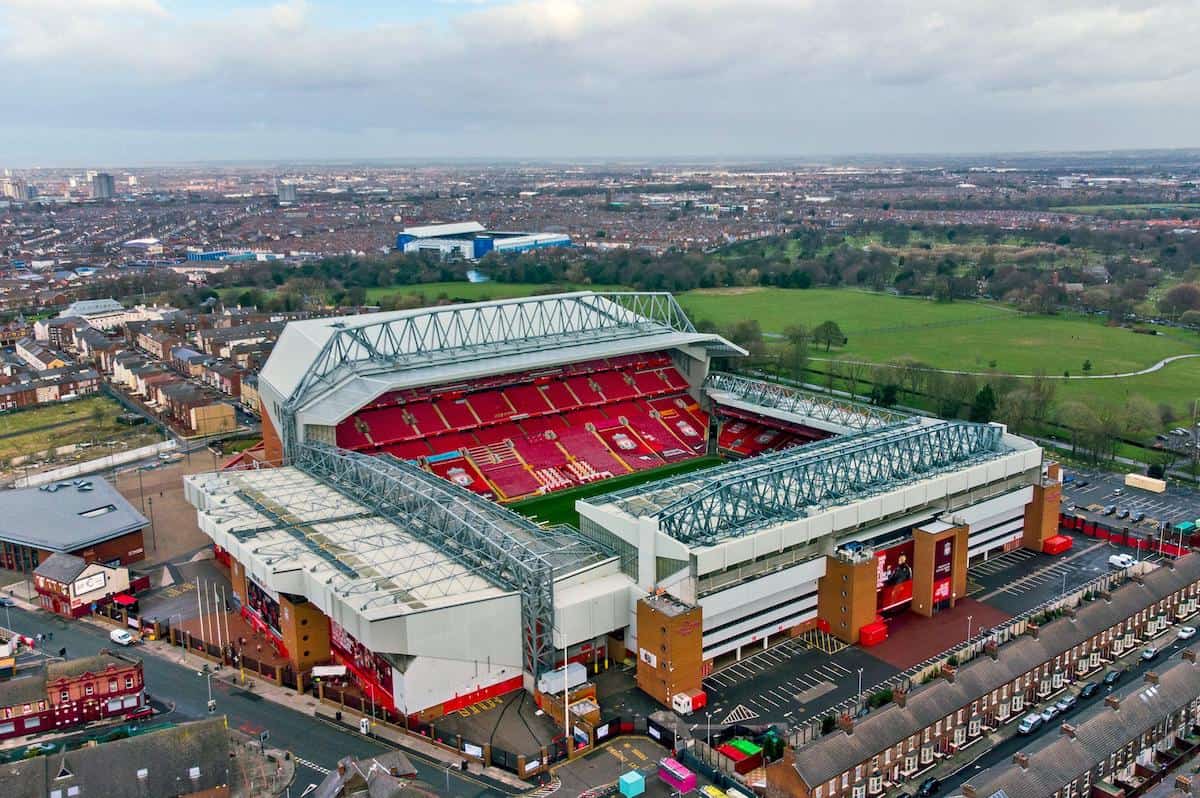
There are grounds you visit for the architecture, grounds you visit for the history, and grounds you visit because you need to know what it actually feels like to stand in that away end when the Kop is in full voice. Anfield is the third kind. It has been written about more than almost any other ground in England, which means most of what you've read is either hagiography or backlash — and neither is quite right. What it actually is, is a proper football ground that has grown into something enormous without entirely losing the terraced-street bones it was built on. That tension is what makes it worth the trip.
Where They Come From
Liverpool is a city that has always had a complicated relationship with the rest of England, and that shows in its football. Anfield sits in L4, a few miles north of the city centre, in a residential neighbourhood of tight Victorian terraces and corner shops that has never been gentrified into something unrecognisable. The ground didn't move to a waterfront development or a retail park on the ring road — it stayed put, expanded around itself, and the streets around it still smell like matchday the moment you turn off Walton Breck Road. Liverpool FC is not a local club in the narrow sense — the global support is vast and occasionally overwhelming — but the community around Anfield is real, and on a European night especially, you feel it in the air before you've even reached the turnstiles.
Four Sides
Anfield holds just over 61,000 now, after successive expansions to the Main Stand and, more recently, the Anfield Road End. The Main Stand on the west side is the newest and most imposing structure — a vast, multi-tiered thing that looms over Anfield Road and dwarfs everything around it. It is undeniably impressive and undeniably corporate in the way that modern stands are, all glass and steel and hospitality levels. The Centenary Stand runs along the east side, functional and relatively low-slung by comparison. The Anfield Road End, recently redeveloped and expanded, now holds the away supporters in its lower tier and has shed some of its old character in the process — though it is at least covered and properly enclosed. And then there is the Kop. The Spion Kop at the north end is the reason people make the trip. It is a single-tier stand holding around 12,500 seated supporters, and when it is full and loud it is one of the most concentrated walls of noise in English football. The old terrace was demolished in 1994 but the stand that replaced it has inherited something of the original's intensity. The floodlight pylons are gone — replaced by modern uprights on the roof — but the shape of the place, the way the Kop curves and rises, still carries the memory of what it was.
Away Day Reality
Away fans are housed in the lower tier of the Anfield Road End, which since the redevelopment is a significant improvement on what was there before. You're covered, the sight lines are decent, and the allocation — when full — gives you enough bodies to make some noise. The view of the Kop from the away end is genuinely something: you can see the full sweep of it, the flags, the banners, the choreography on big nights. What you won't get is any sense of intimidation from the home support in the way you might at some grounds — Anfield is loud but it is not hostile in the way that, say, a packed lower-league end can be. The stewarding is thorough. The atmosphere in the away end depends almost entirely on who you've brought with you.
The Walk In
The nearest train stations are Kirkdale and Bank Hall, both on the Merseyrail Northern Line, and both around a twenty-minute walk to the ground — manageable and well-trodden. From Lime Street it is closer to forty minutes on foot, so most people take the bus or a cab from the city centre; the 17 and 26 bus routes run directly to Anfield Road and drop you within two minutes of the turnstiles. If you're walking from Kirkdale, you come in along Walton Breck Road, past the pubs and the scarves and the noise building as you get closer, and it is a proper football walk — the kind that reminds you why you do this. The streets around the ground fill up quickly in the hour before kick-off, so give yourself time. Parking is tight and the surrounding roads are residential; most away fans are better off coming in by public transport.
Their Story
The story of Liverpool FC is, in many ways, the story of English football's post-war era. Bill Shankly arrived in 1959 and found a Second Division club with a crumbling ground and rebuilt it into something that would dominate the next three decades. Bob Paisley, his quiet, brilliant successor, won six league titles and three European Cups. The 1980s brought more of the same, and then Hillsborough in 1989 — a disaster that reshaped the club, the city, and eventually the laws around football safety in England. The years between 1990 and 2020 were defined by near-misses and the weight of expectation, until Jürgen Klopp arrived in 2015 and rebuilt the club with a ferocity and joy that felt genuinely new. The Premier League title in 2020, the Champions League in 2019 — Liverpool are back at the summit, and Anfield under a full house on a European night is the proof of it. The challenge now, post-Klopp, is whether the next chapter can carry the same charge.
Before and After
The pubs around Anfield are plentiful and close — this is one of the most pub-dense approaches to any ground in the country. None of the venues in the immediate area have confirmed away-friendly status in the data available, so the honest advice is to use your judgement: if you're in away colours on a derby day, be sensible about where you drink. On a standard matchday, the atmosphere around Walton Breck Road is generally good-natured.
- The Park Pub Anfield (216–218 Walton Breck Rd) — right on the main approach road, rated well by regulars and very close to the ground.
- The Albert Pub Anfield (185 Walton Breck Rd) — a few doors down from The Park, similarly well-regarded and convenient.
- The World Famous Arkles (77 Anfield Rd) — the name does a lot of work, but it is genuinely one of the most recognisable pubs in the area, just around the corner from the away end.
- The Sandon (166–182 Oakfield Rd) — historically significant as the pub where Liverpool FC was effectively founded in 1892; worth a visit for that alone, and it holds up as a matchday pub in its own right.
- Taggy's Bar & Beer Garden (21 Anfield Rd) — the highest-rated pub in the immediate vicinity, with a beer garden that earns its keep on a dry afternoon.
- The Thomas Frost – JD Wetherspoon (177–187 Walton Rd) — about a kilometre out on Walton Road; the reliable Wetherspoon option if you want cheap pints and no surprises before the walk in.
Inside the ground, the concourse food is what you'd expect from a Premier League operation — pies, hot dogs, the usual — and it is priced accordingly. The matchday programme is well-produced if you collect them. The real reason to be inside early, though, is to hear the Kop build before kick-off: when "You'll Never Walk Alone" goes up before a big match, it is one of those moments in English football that you either dismiss as theatre or feel in your chest. Most people, the first time, feel it in their chest.
Track every ground you visit
Log your visits, discover new grounds nearby, and see your groundcount grow.
| Download on the App Store | Get it on Google Play |