Toughsheet Community Stadium — Bolton Wanderers
Bolton's out-of-town ground has worn more names than most clubs have had managers, but beneath the sponsorship churn sits a proper Football League ground worth the trip.
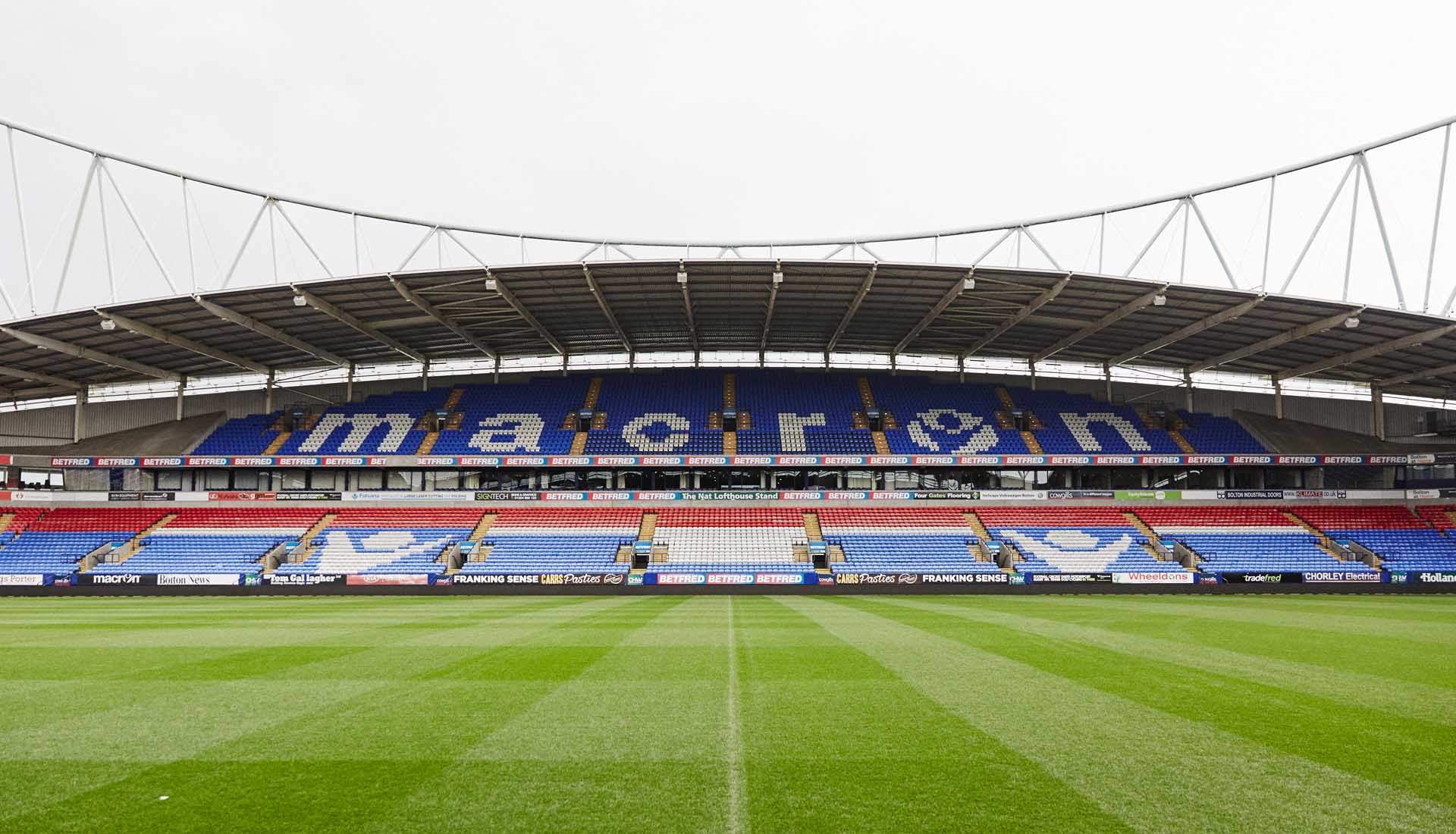
Bolton Wanderers left Burnden Park in 1997 and built themselves a 28,000-seat ground on the edge of Horwich that has since been called the Reebok, the Macron, the University of Bolton, and now the Toughsheet Community Stadium. The name changes so regularly that most Bolton fans just say "the ground" and leave it at that. What hasn't changed is what's inside: a compact, well-proportioned bowl that punches above its weight when the Wanderers are on a good run, and a location so deep in retail park territory that the matchday approach feels like no other ground in the Football League.
The Place That Made Them
Bolton is a mill town that grew up in the shadow of Manchester, twelve miles to the south-east, always slightly overlooked, always capable of producing something unexpectedly good. The club spent much of the 2000s in the Premier League, sending England internationals out onto a pitch backed by the West Pennine Moors, before a financial collapse sent them tumbling down through the divisions in a way that still stings. The ground itself sits not in Bolton proper but in Horwich — a separate town to the north-west — which gives the whole setup a slightly displaced quality, as though the club was reaching for something bigger and got caught between two places. That tension between ambition and circumstance is very Bolton.
First Impressions
The Toughsheet Community Stadium rises out of the Middlebrook Retail and Leisure Park like someone parked a proper football ground next to a multiplex and a Harvester. It's a surreal arrival — you walk past TGI Fridays and a bowling alley before the floodlight pylons (four modern uprights, functional rather than beautiful) come into proper view. Once you're through the turnstiles, though, the ground earns its keep. All four stands are covered, the roof comes down low enough to trap the noise, and the sight lines are good from almost every seat. The South Stand is the main home end, the North Stand faces it, and the East and West Stands fill out a neat rectangle. It's a 1990s purpose-built ground, so you won't find the wonky charm of a terrace wedged against a railway embankment, but it's well-made and it ages better than many of its contemporaries. The sponsor name on the fascia has changed so many times that even the stewards occasionally look uncertain about what to call it.
Away Day Reality
Away supporters are housed in part of the South Stand — seated, covered, and with a decent enough view of the pitch. It's not the most atmospheric away end in League One or wherever Bolton happen to be sitting that season, but it's honest. Legroom is acceptable, the roof holds the sound when the away following is loud, and there's no pillar in your way. The segregation is firm but not hostile — you'll get the usual corridor of stewards but nothing to make you feel unwelcome. Bolton's own support can generate real noise when the side is flying, and on a big matchday that bounces off the roof and reaches you in the away end whether you want it to or not. Bring a voice.
The Walk In
This is where the ground's location becomes its defining characteristic. Horwich Parkway station was built specifically to serve the ground, and on matchday it's a five-minute walk — one of the shortest and most direct station-to-turnstile journeys you'll find anywhere in English football. Trains run from Bolton town centre and from Manchester Victoria via Wigan. The walk takes you straight through the retail park, past the restaurants and the cinema, which makes it feel less like a traditional matchday approach and more like a Saturday afternoon that suddenly became a football trip. If you're driving, there's substantial car parking in the retail park complex, though it fills quickly on big fixtures. Burnden Way runs right to the ground — you won't get lost.
The Arc
Bolton Wanderers were a founder member of the Football League in 1888, won the FA Cup three times in the 1920s, and had Nat Lofthouse — the Lion of Vienna — leading their line for over a decade after the war. The modern era gave them Sam Allardyce, Jussi Jääskeläinen, Jay-Jay Okocha, and a run of eight consecutive Premier League seasons that few would have predicted from a Lancashire town of this size. Then came the collapse: owner changes, unpaid wages, points deductions, administration, relegation from League One in 2019 in circumstances that felt almost deliberate in their cruelty. The recovery since has been steady rather than spectacular, which suits a club that has learned not to trust spectacular. There's a resilience here that you feel when you sit in that ground on a winter afternoon — these supporters have seen the floor drop out, and they came back.
The Full Day Out
The pre-match options around the ground are almost entirely chains, which is fine if you're not precious about it. Several are within a very short walk of the away turnstiles:
- Luciano's at Middlebrook (Middlebrook Retail & Leisure Park, The Linkway) — a well-rated spot right on the doorstep of the ground; no specific notes on away friendliness but handy for a pre-match sit-down.
- Harvester Horwich Park Bolton (Arena Approach) — the Harvester is a reliable if unglamorous option for food before the match, just a couple of minutes from the turnstiles.
- Blanco Lounge (The Linkway) — highest-rated of the immediate options on Google, a good shout if you want something a bit more relaxed than a chain pub.
- Las Iguanas Bolton (Middlebrook Retail & Leisure Park) — worth mentioning if you want a proper meal rather than a pint and a bag of crisps; rated well and close by.
- Bee Hive (Chorley New Road) — about a kilometre out, more of a traditional pub feel than the retail park options if you'd rather avoid the multiplex atmosphere.
Inside the ground, the pies are solid — Bolton has always taken the food offering reasonably seriously, and you're unlikely to leave hungry. Pick up a programme; it's one of the better ones in the lower divisions, and given how much the club has been through, there's usually something worth reading in it. When the Wanderers are on a roll and the South Stand is bouncing, the noise in this ground reminds you why it was built the size it was.
Track every ground you visit
Log your visits, discover new grounds nearby, and see your groundcount grow.
| Download on the App Store | Get it on Google Play |