Montgomery Waters Meadow — Shrewsbury Town
A modern bowl on the edge of town that splits opinion, but Shrewsbury Town make it their own. Worth the trip to Salop if you love lower-league football done properly.
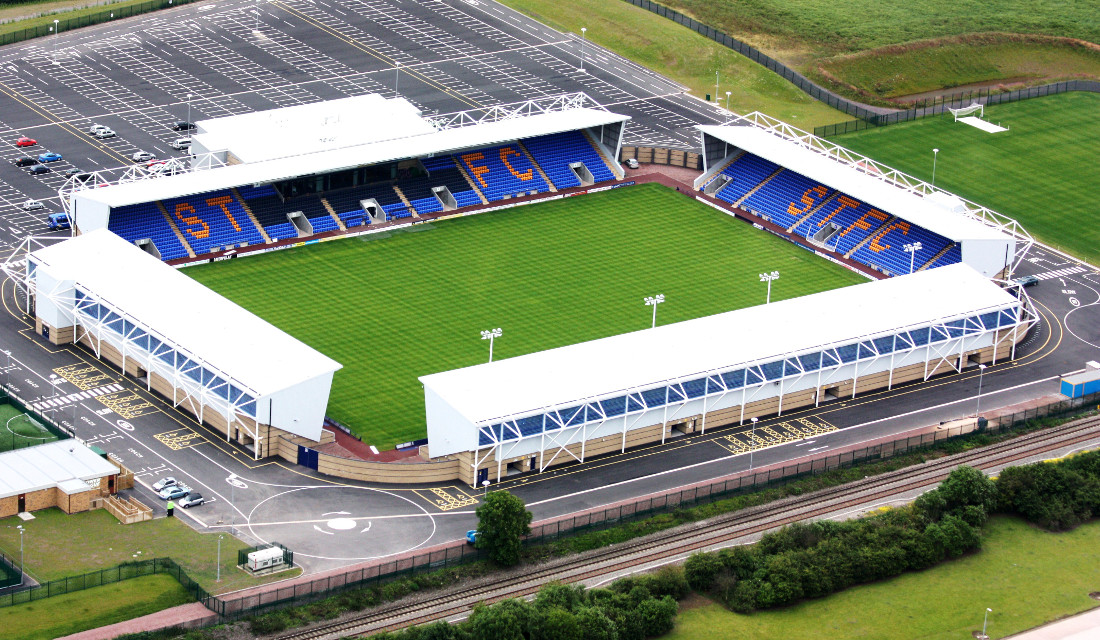
Montgomery Waters Meadow is not a ground that will make you catch your breath the moment you clap eyes on it. It's a neat, modern bowl built on the southern fringe of Shrewsbury, opened in 2007 after the Shrews finally gave up on the old Gay Meadow — a riverside ground of such stubborn charm that it had a man in a coracle fishing footballs out of the Severn. That backstory matters, because it sets the standard this place has always been measured against, and probably always will be. But get inside on a decent matchday with a full away end and a home crowd that means it, and you'll find something worth the journey.
Town and Club
Shrewsbury is an English market town of real character — a loop of the River Severn, black-and-white timbered buildings, a castle, and a geography that makes it feel slightly set apart from everywhere else. It sits in Shropshire, which is one of those counties that England seems to have filed under "somewhere in the Midlands" and mostly forgotten about. That suits Shrewsbury Town fine. They are the county's club in a way that bigger, noisier places rarely are — there's no Premier League outfit round the corner swallowing up the talent and the casual supporter, which gives the Shrews a certain groundedness. This is a club that belongs to its place.
First Impressions
The ground goes by a few names depending on how long you've been following it. It opened as the New Meadow, spent years as Greenhous Meadow for sponsorship reasons, and is currently known as Montgomery Waters Meadow — which at least sounds like something from a Thomas Hardy novel and does the town a bit of justice. Locals tend to shorten it to the New Meadow regardless. It sits on Oteley Road, south of the town centre, surrounded by retail parks and a dual carriageway that makes the immediate approach feel more like a trading estate than a football ground. But the ground itself is tidy enough: four stands of similar height wrapped around the pitch, with floodlight pylons at each corner of the structure rather than towering separately. The Main Stand runs along the west side and carries the main facilities. All four sides are covered, which is not nothing when you're playing in League One in February. The sight lines are decent throughout, and the pitch is well maintained. Is it beautiful? No. Does it do the job? Very much so.
Away Day Reality
Away supporters are housed in the South Stand, which gives you a covered terrace and a reasonable end-on view of the pitch. It's compact rather than cavernous, which means that if you've travelled in numbers — and some away followings do make the trip to Shrewsbury worth celebrating — you'll generate proper noise. The sight lines from the away terrace are fine; you're not peering round pillars or straining to see the far corner. The stewards are generally sensible. Shrewsbury supporters are not particularly hostile to away fans — this is a club whose own fanbase knows what it is to travel hopefully — so expect a bit of banter rather than anything uglier.
The Walk In
Shrewsbury train station is a solid thirty-three minute walk from the ground, which is on the long side but entirely manageable if the weather cooperates and you give yourself enough time. The route out along Oteley Road is not exactly scenic — you'll pass a retail park and a petrol station — but it's straightforward and well-trodden on matchdays. Buses run from near the station and stop within seven or eight minutes' walk of the ground, which is the sensible option if you'd rather not arrive having already done a 5k. If you're coming by car, there is parking in and around the ground, and the surrounding road network — while not great — is passable outside of peak times. Come early either way.
How They Got Here
Shrewsbury Town were a Football League club from 1950, and their best years came in the early 1980s when they reached the old Second Division under Graham Turner — the highest level they'd ever played at. That era feels genuinely distant now. The Shrews dropped out of the Football League entirely in 2003, spent three seasons in the Conference, and came back up in 2004 under Dave Longhorn. The move to the New Meadow in 2007 was part of a broader effort to build something more stable, and they've been a League One fixture more often than not in recent years, occasionally threatening the Championship play-offs and occasionally going the other way. Paul Hurst, Sam Ricketts, Steve Cotterill — there's been a proper managerial turnover, as you'd expect at a club of this size. But they've stayed in the Football League, kept the lights on, and built a fanbase that genuinely shows up. In the lower leagues, that's its own kind of success.
Pubs, Pies & Matchday
The pub situation near the ground is limited by the location — this is not a ground you can stumble to from a high street full of options. There are a handful of places within reasonable distance, none of them verified as reliably away-friendly, so read the room carefully depending on the occasion.
- Smithy's Bar (Montgomery Waters Meadows, Oteley Rd) — the bar inside or immediately adjacent to the ground itself; convenient if you just want something quick before kick-off.
- Rad Beer (Hereford Rd, Meole Brace, approx. 559m) — a highly-rated local option with a 4.8 Google score, which suggests they're doing something right; worth a look if you're early and want something decent.
- The Brooklands Pub and Restaurant (Mill Rd, Meole Brace, approx. 609m) — a pub-restaurant a short walk away; more of a mixed crowd, nothing to worry about but nothing particularly noteworthy either.
- Saddlers (Whitecroft Rd, approx. 1km) — a bit further out; neighbourhood local, fine if you're in the vicinity.
Inside the ground, the pies are reliable rather than remarkable — standard matchday fare. The programme is worth picking up if you like a proper read; Shrewsbury put effort into theirs. The home support tends to gather at the northern end, and on a good day — a promotion push, a cup tie, a derby against a League One rival — the noise from that end makes the ground feel considerably bigger than its near-ten-thousand capacity suggests.
Track every ground you visit
Log your visits, discover new grounds nearby, and see your groundcount grow.
| Download on the App Store | Get it on Google Play |