Kirklees Stadium — Huddersfield Town
One of English football's great 1990s purpose-built grounds, the Kirklees has worn many names but never lost its distinctive character in the West Yorkshire hills.
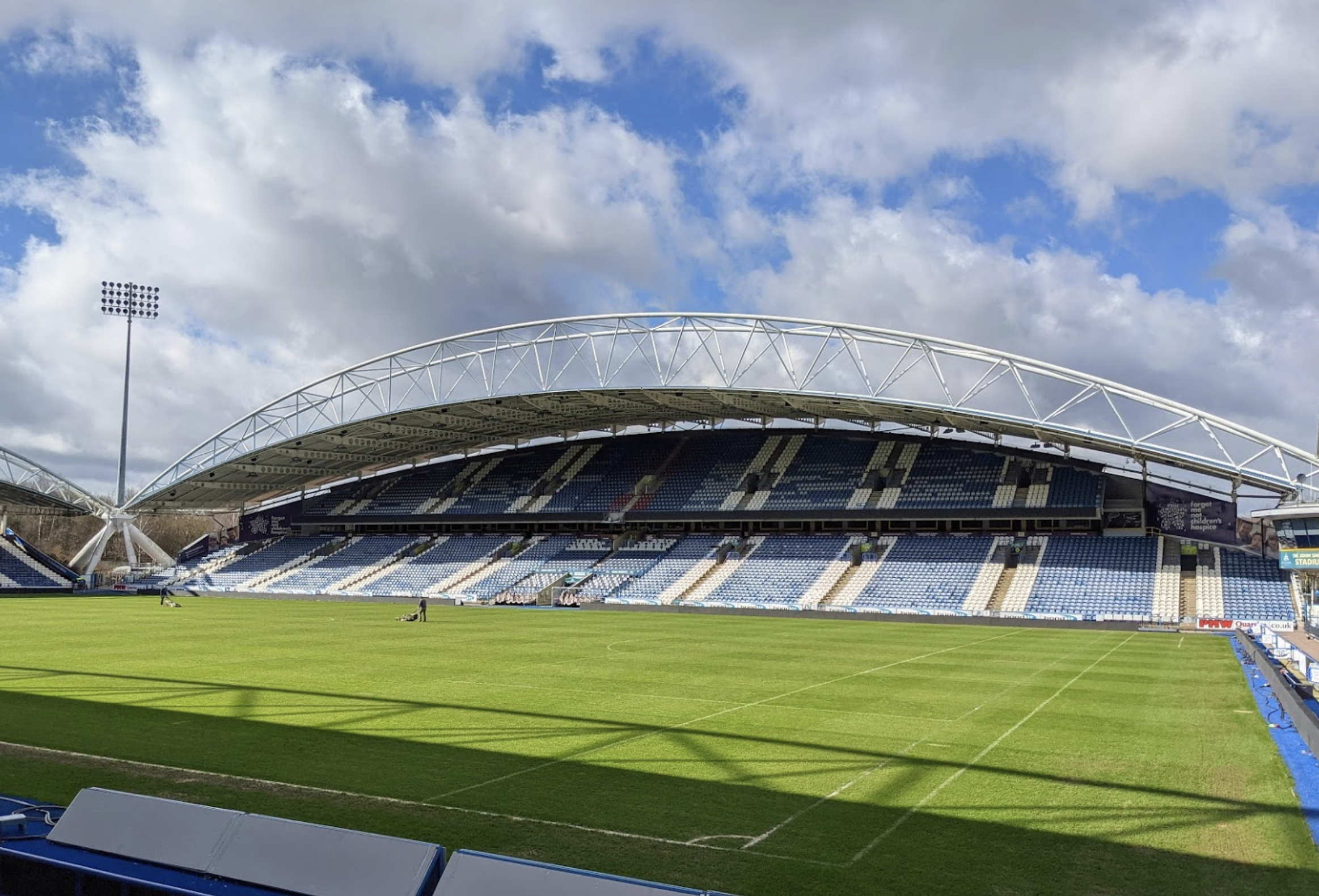
There's a decent argument that the Alfred McAlpine — whatever name it's trading under this season — was the finest purpose-built football ground of the 1990s boom. Not the biggest, not the flashiest, but the one that actually got the balance right: compact, steep, atmospheric, and designed by someone who had clearly been to a football match before. When a lot of that era's new builds were producing glorified retail parks with seats bolted on, Huddersfield opened something genuinely worth the trip.
Where They Come From
Huddersfield sits in a bowl of West Yorkshire hills between Leeds and Manchester, a mill town that reinvented itself after the textile trade collapsed and never quite got the recognition it deserved. Town have always existed in the considerable shadow of their neighbours — Leeds United forty minutes east, Manchester City and United an hour west — which perhaps explains why the club holds its identity tightly. This is a proud, working-class football town, and the Terriers have reflected that over the decades: unfashionable, occasionally brilliant, usually scrapping for something.
First Impressions
You see it from a distance before you reach it — the distinctive white steel arches curving over the roof like a pair of giant bicycle wheels laid on their sides. It was a statement of architectural intent in 1994 when it opened as the Alfred McAlpine Stadium, and it still stops you in your tracks today. The ground has gone through a full cycle of naming rights since — the Galpharm era, then thirteen years as the John Smith's Stadium, and now the Accu Stadium for commercial reasons — but locals have always had their own shorthand, and the architecture doesn't care what the sponsors call it.
Inside, what strikes you is how well the four stands work together. All four sides are covered, all four sides are steep enough to generate real noise, and the corners — often the dead zones in modern grounds — are filled in with seating that keeps the sound bouncing around the bowl. The main stand along the west side has a decent upper tier. The Revell Ward Stand to the north and the Fantastic Media Stand opposite are both proper covered ends that do what ends are supposed to do. The floodlights sit atop the roof structures rather than on separate pylons, which keeps the sightlines clean. It's a coherent design, which puts it ahead of many grounds built in the same era.
For the Travelling Support
Away fans are housed in the south stand — the PPG Canalside Stand end — and it's a fair allocation. You get a covered terrace for lower-league visits, or seating depending on the fixture and expected numbers. The rake is steep enough that sightlines are good throughout, and because the corners are enclosed, the noise from both ends connects rather than escaping into the sky. The home support in the north end can be vocal, and when Town are on form, the ground generates proper sound. Away fans are treated with reasonable civility — this isn't a ground where you'll feel unwelcome, just one where the locals will make clear they'd rather you weren't three-nil up.
The Walk In
Huddersfield train station is roughly sixteen minutes on foot — a straightforward walk north-east out of the town centre, over the ring road and along Stadium Way. It's not the most scenic approach in the Football League, threading through retail and light industrial, but the ground announces itself long before you arrive. If you're driving, there's parking around the retail park adjacent to the ground, though on a big matchday it fills early. The town centre itself is worth arriving for — Huddersfield is an underrated day out, with a genuinely handsome Victorian centre around St George's Square and a decent pub scene near the station.
The Arc
Huddersfield Town's story is one of English football's more dramatic long arcs. Herbert Chapman managed them to three consecutive First Division titles in the 1920s — a feat that has never been matched, and one that gets overlooked because Chapman subsequently did the same trick at Arsenal and history tends to remember where you finished. Decades of mid-table respectability and occasional lower-league struggle followed. Then came the David Wagner years: a Bundesliga-shaped pressing philosophy arrived in West Yorkshire, Town went up via the Championship play-offs in 2017, survived a Premier League season, and promptly unravelled. They've been rebuilding since, working their way through the Championship and League One, reminding you that the gap between the top of the game and the rest of it has never been wider.
Before and After
The pub situation around the ground itself is limited — Stadium Way is not a pub street. Your best move is to arrive in town early and drink near the station, where there are several solid options on and around St George's Square and John William Street. The Head of Steam at the station itself is a reliable Wetherspoons-adjacent choice for away fans looking for no fuss. Inside the ground, the catering is functional rather than inspired — the pies are acceptable, the queues manageable if you time it right. The matchday programme is worth picking up if you're groundhopping; Town put reasonable effort into it. What you're really there for, though, is the bowl itself when it fills up — because even at two-thirds capacity, this ground sounds like it means it.
Track every ground you visit
Log your visits, discover new grounds nearby, and see your groundcount grow.
| Download on the App Store | Get it on Google Play |