Field Mill — Mansfield Town
Field Mill is one of the oldest grounds in football. Mansfield's compact, characterful home rewards the groundhopper willing to make the trip into Nottinghamshire.

Field Mill makes a reasonable claim to being the oldest continually used football ground in the world, having hosted matches since 1861. That alone should be enough to get a groundhopper out of bed on a Saturday morning, but what keeps you coming back is that it doesn't trade on the history — it just quietly gets on with being a proper, functioning football ground in a proper football town. There's nothing heritage-trail about it. It's compact, it's loud when it needs to be, and it sits in Mansfield like it has always sat in Mansfield, which of course it has.
Where They Come From
Mansfield is the kind of East Midlands mining town that English football was essentially invented for. The collieries are long gone but their shadow is still here — in the terraces, in the accents, in the way the supporters treat a home win as something that matters rather than just a result. Squeezed between Nottingham to the south and Sheffield to the north, the town has always lived in the footballing shadow of its bigger neighbours, which tends to concentrate loyalty rather than dilute it. Mansfield Town supporters have no interest in apologising for where they're from. That's the best kind of fan base.
Four Sides
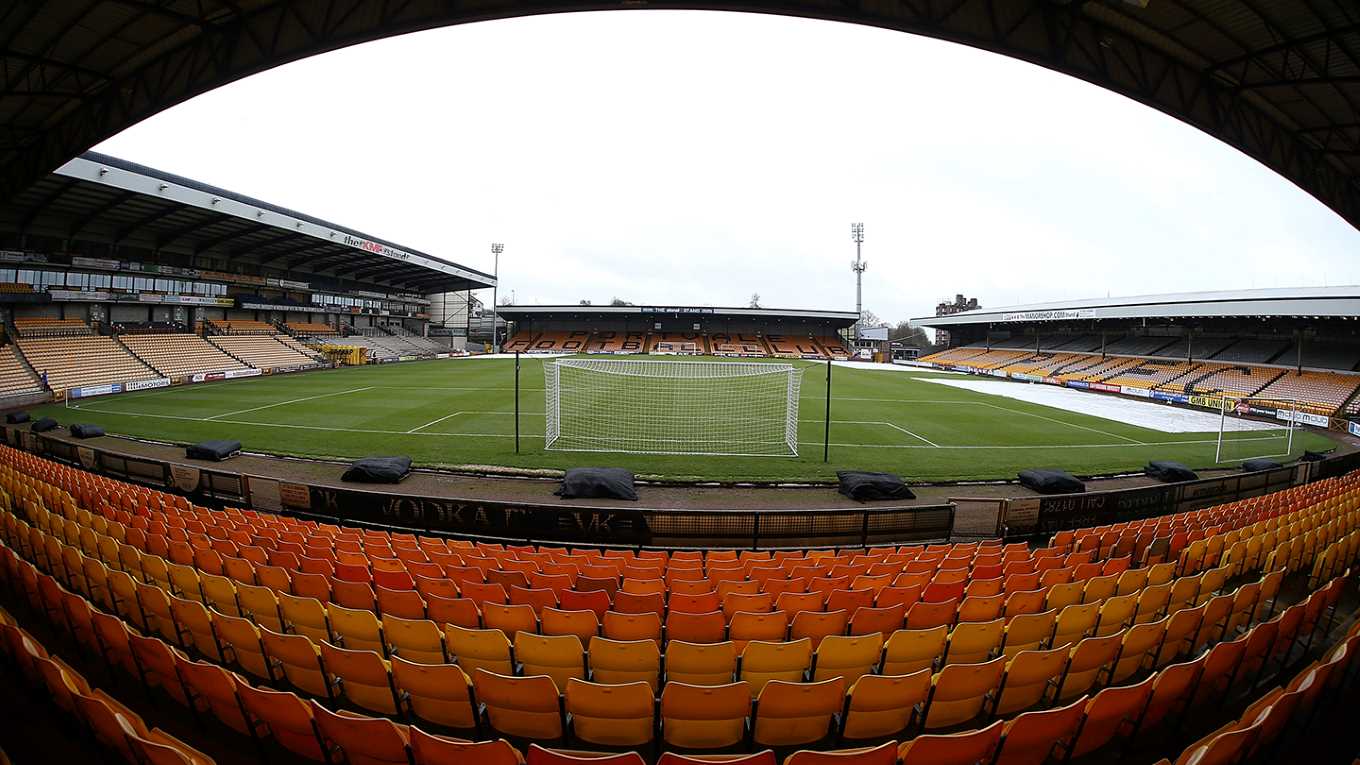
Field Mill holds just over nine thousand and, at that size, it does something larger grounds can't — you're always close to the pitch. The Ian Greaves Stand is the centrepiece of the main structure, a modern seated affair that replaced what came before it. The North Stand is covered terracing behind the goal and is where the noise congregates. Opposite, the South Stand — older, lower — keeps its head down and watches the game. The West Stand completes the rectangle. Floodlight pylons of the older, angular variety sit at the corners, which is exactly correct as far as I'm concerned. There's a snugness to Field Mill that modern grounds engineered for six times the capacity can't manufacture. The pitch sits slightly lower than the surrounding structure, which helps with the atmosphere — sound bounces rather than escaping into the sky.
The Away End
Away supporters are housed in the South Stand, which is seated and partially covered. It's not going to win any prizes — the roof doesn't extend far enough to keep determined Midlands rain entirely off you, and the leg room is what you'd diplomatically call in keeping with the ground's character. But the view of the pitch is decent, and you're close enough to the action to feel involved. Home supporters in the Ian Greaves Stand are visible across the pitch, and on a lively day there's a proper exchange. Hostility depends on the fixture — derby days against Chesterfield or Notts County bring extra heat, but most visiting supporters leave without complaint. Travelling fans who show decent numbers get a reasonable return.
The Walk In
Mansfield station is a six-minute walk from Field Mill, which is almost suspiciously convenient for a groundhop. The Robin Hood Line drops you in, you head up towards Quarry Lane, and the floodlight pylons appear before you've had time to find your ticket. The ground announces itself on Quarry Lane without fuss — no grand approach, no boulevard — just the stand appearing between terraced houses and a retail park. If you're driving, there's parking available around the Mansfield Leisure Park on Nottingham Road, but on a busy matchday you'll do better arriving early or using the station and walking. Nottingham is about forty minutes by road if you're coming down from the north or up from the south; the Robin Hood Line connects through Nottingham, making it a reasonable cross-county day trip.
How They Got Here
Mansfield Town spent the bulk of the late twentieth century yo-yoing between the third and fourth tiers, occasionally threatening and occasionally threatened. They dropped into the Conference — what is now the National League — in 2008, which for a club of their standing was a grim few years. The turnaround came in 2013 when they won the Conference title and returned to the Football League, and since then there's been a gradual upward trajectory under various managers that has settled the club as a legitimate League Two and occasionally League One presence. The recent ownership period has brought investment and ambition, though whether that translates into sustained promotion challenges or comfortable consolidation probably depends on the season you're reading this. Either way, the club is in better shape than it was. Field Mill, across all of it, has stayed the same.
Pubs, Pies & Matchday
There are options close to the ground and more variety as you head into the town centre on Nottingham Road and Stockwell Gate, a ten-minute walk from Field Mill. Since none of the nearby pubs have confirmed away-friendly status, your safest approach is to make your own judgement on the day — colours in, see how it feels. Close to the ground, the Talbot Inn (151 Nottingham Rd, Mansfield NG18 4AE) is about five minutes away and rated solidly. The Railway Inn (9 Station St, Mansfield NG18 1EF) is handy if you're arriving by train and want to stop before making the walk. Further into town, the Bold Forester on Botany Avenue and the William IV on Stockwell Gate are both well-regarded locals worth checking. The Capo Lounge on Stockwell Gate is a reliable chain option if you want something more predictable. Inside Field Mill, the pies are honest rather than extraordinary — a Stags matchday pie will fill the gap between the train and kick-off without any particular incident, which is what you want. Pick up the programme; for a club with Field Mill's history, there's usually something worth reading in the historical notes.
Track every ground you visit
Log your visits, discover new grounds nearby, and see your groundcount grow.
| Download on the App Store | Get it on Google Play |