County Ground — Swindon Town
Open since 1892 and still standing on County Road, Swindon's ground is a proper old English football venue with enough character to justify the trip.
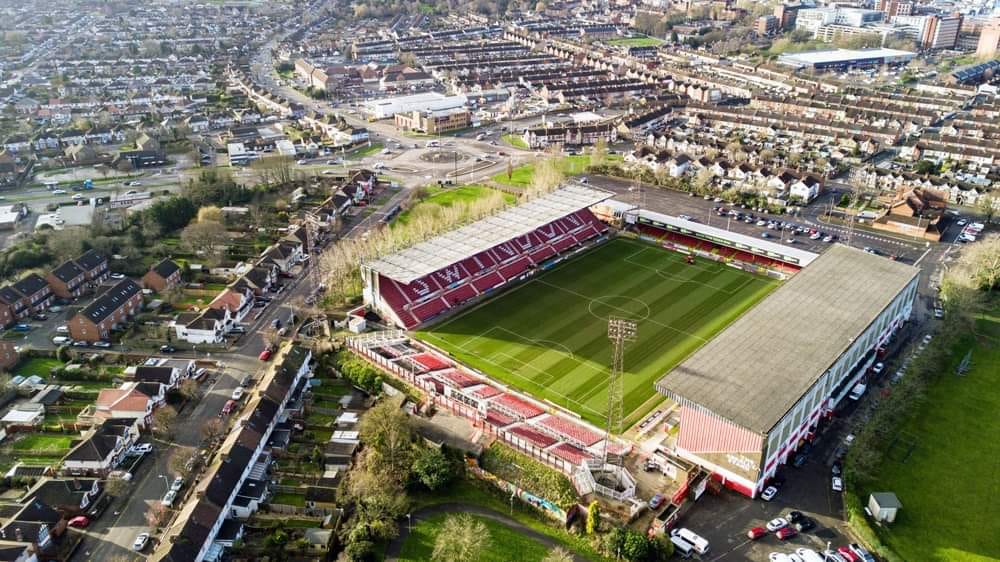
Swindon Town's County Ground is one of those grounds that earns your respect quietly. It doesn't announce itself with a dramatic skyline or a gleaming new facade — it just sits there on County Road, doing what it's been doing since 1892, and dares you to find somewhere with more accumulated atmosphere per square metre. For the groundhopper, that longevity is the whole point.
The Place That Made Them
Swindon is a Great Western Railway town through and through — built on engineering, expanded by the works, defined by that particular Wiltshire working-class pride that sits somewhere between stubbornly local and quietly underestimated. It's not a glamorous footballing city. It's surrounded by bigger clubs pulling at the edges of its catchment: Bristol to the west, Reading to the east, Oxford to the north. And yet Swindon Town have always been unmistakably Swindon, never an afterthought in their own town, never subsumed. The County Ground, right in the middle of a residential neighbourhood, reflects that exactly.
Four Sides
The ground has four distinct stands and each one feels like it belongs to a different decade, which is part of the charm. The Town End behind one goal has proper terracing — still standing, still loud, still the heart of things on a matchday. The Stratton Bank, now seated, retains that sloped character that tells you it was once a proper bank of standing supporters packed in tight. The main stand on County Road has that covered, slightly cramped dignity of a structure that has seen better days and doesn't much care. The Don Rogers Stand is the newest addition, named for the man who scored two in extra time at Wembley in 1969, which is one of those pieces of naming that makes you feel something before you've even sat down. Floodlights are the older pylon style — proper ones, the kind that glow orange and tell you something important is about to happen. The pitch dimensions are on the compact side, which keeps the noise close to the action, and the whole place feels deliberately, unapologetically old-school English football.
Away Day Reality
Away fans are typically housed in the Stratton Bank end, which is covered and offers a decent enough view, though the sight lines from some positions aren't exactly generous. It's not palatial, but it's honest — you're in a real football ground, not a corporate bowl, and the fact you can hear the home support properly from where you're standing is a feature, not a bug. Relations between home and away supporters tend to be competitive rather than hostile; Swindon fans are passionate and vocal, particularly when things are going well, but there's no particular edge about the place that should put travelling supporters off making the trip.
The Walk In
Swindon station is on the mainline from London Paddington — fast and frequent — and from there it's a thirteen-minute walk to the ground. Head north from the station, up through the town centre, and County Road will find you before you're quite ready for it. The ground appears out of a residential street the way proper football grounds always used to, with no warning, no approach road, no signage telling you how excited you should feel. You'll know it by the floodlights and the sound. Street parking in the surrounding residential streets is an option if you're driving, though it fills up quickly and the neighbours have long since adapted.
Their Story
Swindon Town's greatest hour came at Wembley in the 1969 League Cup final, when they beat Arsenal — then a First Division side — through Don Rogers' brilliance. That result remains the lodestone moment, the one that tells you what this club is capable of. Under Ossie Ardiles in the early 1990s they played some of the most expansive football in the country, won promotion to the old First Division, and briefly stood on the edge of something extraordinary before financial reality intervened. The years since have been a long negotiation between ambition and resource — relegations, administrations, ownership controversies, the occasional surge back upward. Where they sit now is a club rebuilding with supporters who know exactly what this ground has seen and aren't about to let anyone forget it.
Pubs, Pies & Matchday
There are several options within reasonable walking distance of the ground, though none of the nearby pubs have confirmed away-friendly status, so a degree of common sense applies — especially on derby days. The closest options are within a kilometre, and the Merlin on Drove Road and the Hungry n Thirsty on Cricklade Road have good local ratings if you fancy a pre-match pint in a proper neighbourhood pub. For something more reliably neutral, the town centre is a fifteen-minute walk and has a Wetherspoon — The Savoy on Regent Street — which will do what it always does, reliably and without fuss. Inside the ground, the pies are competent rather than exceptional, and the programme is worth picking up if you're doing this properly. The Town End generates the best noise when Swindon are on top, and when this place gets going — a decent crowd, floodlights on, something at stake — it reminds you exactly why you got into groundhopping in the first place.
Track every ground you visit
Log your visits, discover new grounds nearby, and see your groundcount grow.
| Download on the App Store | Get it on Google Play |