Club Doncaster Sports Village — Doncaster Rovers
Opened in 2007 on a retail park south of town, Donny's ground has worn several names but the football underneath hasn't changed — honest, loud in patches, worth the trip.
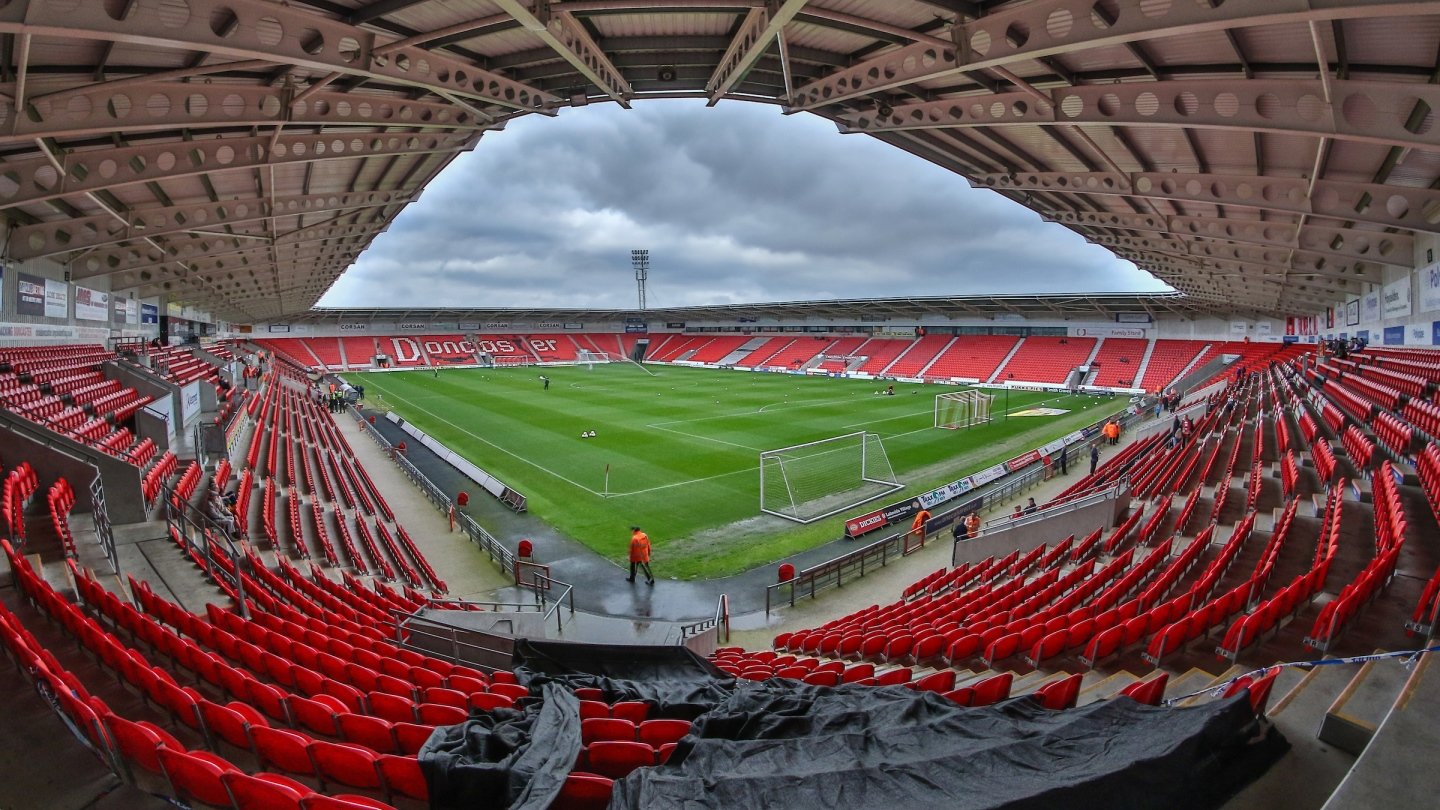
There are grounds that grew organically out of their surroundings over a century, and there are grounds that were built from scratch on reclaimed land beside a leisure park. Doncaster's home is firmly the latter — and yet, somehow, it works. What you get here is a compact, decent modern bowl that the Doncaster faithful have made their own, which is more than you can say for a lot of purpose-built grounds from the same era. Come with the right expectations and you'll leave impressed. Come expecting Belle Vue and you'll have set yourself up for disappointment — but that's on you.
Town and Club
Doncaster is a South Yorkshire railway town, historically built on coal, rail engineering, and a stubborn refusal to be overshadowed by its louder neighbours in Sheffield and Leeds. Rovers are the town's club in every real sense — they've never been glamorous, they've never been fashionable, and they've never really wanted to be. What they are is embedded. The club's support is overwhelmingly local, often multi-generational, the kind of fan base that keeps showing up through the lower leagues and beyond because there's genuinely nowhere else to go. That loyalty, in a town that doesn't have much to shout about from a football-prestige standpoint, gives Doncaster Rovers a character that some clubs with far bigger histories can't quite manage.
Four Sides
Built in 2007 as part of a wider regeneration project on the Lakeside development, the ground opened as the Keepmoat Stadium — a name it held for fifteen years before switching to the Eco-Power Stadium, and more recently settling on the rather more unwieldy Club Doncaster Sports Village for commercial and community branding reasons. Locals have cycled through the nicknames accordingly: the Keepmoat, the Moat, the KMS, the Black Bank. Whatever you call it, the structure itself is a tidy, four-sided bowl, all four stands roofed, with a capacity just over 15,000. The sight lines are good throughout — it's one of those grounds where the design actually worked, with seats raked steeply enough that you don't feel miles from the pitch even in the upper rows. The floodlights are modern uprights mounted on the roof rather than old-school corner pylons, which won't satisfy the traditionalist in you, but they do the job without blocking anyone's view. The South Stand — the home end — generates most of the noise when things are going well, and when it does, you feel it. This is not a cavernous, echoey ground where the sound disappears into the sky. The roof keeps the noise in.
What Away Fans Get
Away supporters are housed in one corner of the North Stand, which is covered and seated. The view is fine — no pillars, decent angle on the pitch, and you're close enough to feel involved. The allocation is typically generous by League One and League Two standards, and the away terrace isn't the kind of grim afterthought you encounter at some grounds of this era. Stewards are professional without being aggressive about it. Home supporters are generally of the indifferent-to-respectful variety when it comes to visiting fans — this isn't a derby atmosphere unless it's actually a derby — so you should have a reasonable afternoon regardless of the result. The acoustics in the away corner can feel a little flat if numbers are low, but bring a decent travelling support and it lifts.
Arriving
This is where it gets honest. The ground sits on Stadium Way, Lakeside, which is effectively a retail and leisure development on the southern edge of Doncaster — think cinema, bowling alley, chain restaurants, and a hotel. Doncaster railway station is a 28-minute walk away, which is entirely doable on a dry day. The walk takes you out of the town centre, past some light industrial stretches, and then into the Lakeside Boulevard approach, which is functional but hardly atmospheric. If the weather's grim, there are buses from the town centre that stop right outside — the Stadium Way stops on Carriage Drive and Lakeside Boulevard are a couple of minutes from the turnstiles. Driving is straightforward; there's a reasonable amount of matchday parking in the surrounding car parks, though you'll want to arrive with time to spare. It's one of those grounds that's slightly easier by car than by foot from the train, but the walk back into town after a match is fine if you fancy it.
How They Got Here
Rovers have done the full ride. They were a Football League club from 1901, drifted down into the Conference by the late 1990s after years of financial mismanagement that left them genuinely close to extinction, then came back — dramatically — through the non-league and climbed all the way to the Championship by 2008. The years around the move to the Keepmoat coincided with the best football the club had seen in decades: Sean O'Driscoll's side, then Brian Flynn's, then Dean Saunders getting them promoted to the second tier. It didn't last — it rarely does for clubs like this — and they've spent most of the years since hovering between the third and fourth tiers. But the near-death experience of the late 1990s gave the fan base a particular resilience. When you've been to the Conference and clawed your way back, League Two on a Tuesday night in January doesn't feel like the end of the world.
The Matchday
The ground is situated in a leisure park, which means your pre-match options are chain pubs and chain restaurants rather than a traditional town-centre boozer. There's a handful of options nearby, though none of them came with verified away-friendly notes from anyone I'd trust with my scarf:
- Belle Vue Bar (Doncaster DN4 5JW, 63m from the ground) — the closest option to the turnstiles, worth checking if you're short on time before kick-off.
- The Lakeside Beefeater (South Entry Drive, White Rose Way, DN4 5PJ, 365m away) — a Beefeater is a Beefeater, but it's close, it's reliable, and it'll serve you a pint and something warm before the match without drama.
- Cheswold Lodge Brewers Fayre (Doncaster Leisure Park, Herten Way, Bawtry Road, DN4 7NW, 679m away) — another chain option on the leisure park, same logic applies. No great romance, but functional.
If you've got time before travelling out to Lakeside, the town centre has proper pubs worth exploring around the market area — far better than anything you'll find in the retail park. Inside the ground, the pies are decent enough — proper hot, nothing to write home about but nothing to complain about either. The programme is a solid effort for this level. And when the South Stand gets behind the team on a night match, particularly in a cup tie or a promotion push, it's genuinely one of the better atmospheres in the lower leagues. This is a modern ground, yes, but Doncaster have made it theirs.
Track every ground you visit
Log your visits, discover new grounds nearby, and see your groundcount grow.
| Download on the App Store | Get it on Google Play |