Turf Moor — Burnley FC
One of England's oldest Football League grounds, Turf Moor sits tight against Burnley's terraced streets — compact, loud, and utterly unimpressed by modern football's gloss.
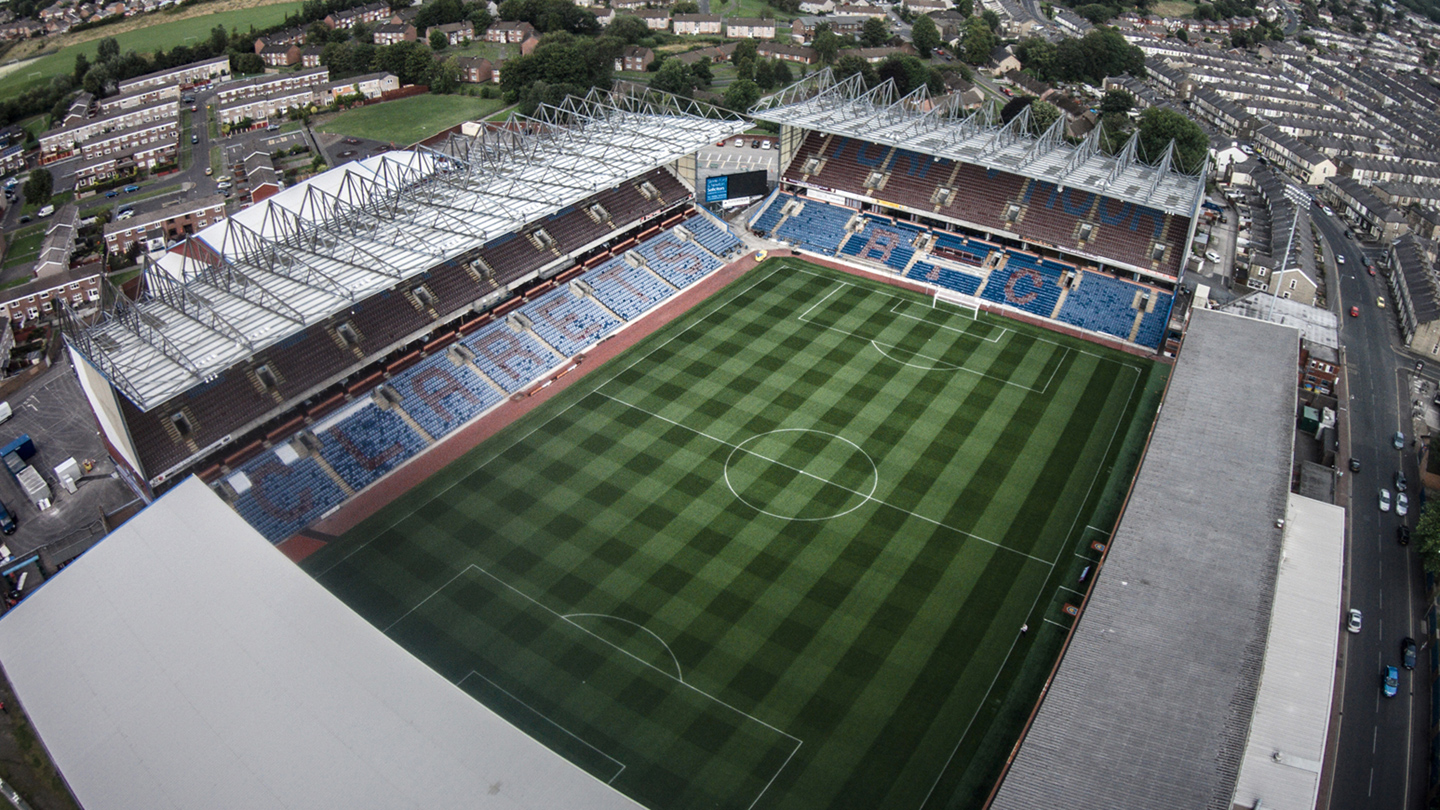
Turf Moor is the kind of ground that reminds you why you started doing this in the first place. It has been here since 1883, it sits in the crease of a Lancashire mill town, and it carries the weight of that without making a fuss about it. This is not a ground that tries to impress you — it just does, quietly and on its own terms.
Where They Come From
Burnley is a town that has never had the luxury of pretending it's somewhere else. Hemmed in by the Pennines, historically built on cotton and coal, it sits in east Lancashire with Blackburn to the west and Nelson to the north — neither of them friends. The club reflects the town completely: stubborn, self-reliant, and deeply suspicious of anything that smells like soft money. For a place of roughly 90,000 people, Burnley FC has spent a remarkable amount of time in the top flight, and the locals know it. There's a pride here that isn't loud but is absolutely immovable. When the Premier League circus rolls in, Turf Moor doesn't dress up for it. The town doesn't change. That's the point.
Four Sides
The ground sits on Harry Potts Way — named after the manager who led Burnley to the First Division title in 1960 — and the street name alone tells you something about how this club thinks about its past. The four stands are compact and close to the pitch, which gives the place a compressed, pressurised feel on a full house. The Bob Lord Stand runs along the main side, a covered all-seater named after the famously combative chairman who shaped the club through the mid-twentieth century. Opposite is the Jimmy McIlroy Stand, honouring the Northern Irish inside-forward widely regarded as the finest player ever to pull on a claret and blue shirt. The Cricket Field Stand at one end is exactly what it sounds like — it backs onto the old Burnley Cricket Club ground, a quirk that gives Turf Moor one of its most distinctive features. The James Hargreaves Stand closes the other end. The floodlight pylons are proper old-school uprights, four corners, no nonsense. The pitch sits slightly below street level on the cricket field side, which adds to the sense of being enclosed, held in. Sight lines throughout are excellent — this is a ground built for watching football, not for corporate hospitality or retail concourses.
The Away End
Away supporters are housed in the David Fishwick Stand — the end behind the goal at the James Hargreaves end, or allocated sections of the Cricket Field Stand depending on numbers. The away allocation is covered and reasonably close to the pitch, with decent sight lines and a roof that actually keeps the rain off, which in east Lancashire is not a trivial consideration. The acoustics are good — the ground is tight enough that noise travels, and a vocal away following will hear itself. Home supporters in the adjacent sections are generally more interested in the match than in giving you grief, though a derby or a relegation six-pointer will sharpen things up considerably. Facilities are functional rather than impressive, but you won't feel like an afterthought. Burnley is a proper football town and it treats away fans like proper football fans — with a certain wary respect.
The Walk In
Burnley Central is your best bet off the train — it's about fourteen minutes on foot, heading south through the town centre and then down towards the ground along Belvedere Road. It's a straightforward walk and you'll pick up the floodlights before long. Burnley Manchester Road station is slightly further at around seventeen minutes but drops you on the other side of town, which some people prefer for the post-match scatter. There are bus stops directly outside the ground on Harry Potts Way if you're coming in from further afield — the stop is literally called Turf Moor, which saves any ambiguity. Street parking exists in the surrounding residential streets but fills quickly; if you're driving, give yourself time. The approach on foot from the town centre takes you through the kind of Lancashire terraced streets that feel entirely continuous with the ground itself — there's no jarring transition from town to football venue. It all belongs together.
The Arc
The story of Burnley FC is essentially a story about refusing to accept what the geography and the economics say you should be. They won the First Division title in 1960 as a town of 80,000 people, competing with Manchester United and Arsenal on merit and on a budget that would make a modern Championship chairman wince. Bob Lord's iron grip kept the club solvent through decades when others were spending themselves into trouble. The decline came anyway — by the 1980s they were in the Fourth Division, nearly dropping out of the Football League entirely in 1987, saved on the final day of the season. What followed was a slow, grinding rebuild that eventually produced two separate Premier League spells in the 2000s and 2010s, the second under Sean Dyche becoming one of the more remarkable sustained overachievements in recent English football history. The yo-yo years since have been painful, but the club's identity has never wavered. Burnley know exactly who they are.
Pubs, Pies & Matchday
The pub situation around Turf Moor is worth planning ahead for. The ground sits in a largely residential area and the immediate vicinity is thin on options, so most supporters — home and away — head into the town centre before the match. Burnley town centre is a ten-minute walk from the ground and has a reasonable spread of pubs along St James's Street and around the bus station. Away fans are generally fine in the town centre, though on derby days against Blackburn you'd want to use your judgement. The Turf Hotel on Yorkshire Street has historically been a pre-match option and is close enough to the ground to be convenient. For away supporters especially, arriving early and drinking in town before walking down is the sensible approach — don't leave it to the last minute and expect to find something on the doorstep. Inside the ground, the pies are taken seriously — this is Lancashire, and a bad pie would be a genuine local scandal. The programme is worth picking up if you're groundhopping; it's one of the more traditional productions in the division. The Bob Lord Stand generates the most consistent noise, but when Turf Moor is full and the Clarets are pressing, the whole ground lifts together in a way that a 21,000-capacity ground really shouldn't be able to manage. It does, though. It always does.
Track every ground you visit
Log your visits, discover new grounds nearby, and see your groundcount grow.
| Download on the App Store | Get it on Google Play |