Bloomfield Road — Blackpool FC
A seaside ground with a battered charm, Bloomfield Road has seen First Division football and near-oblivion. The tangerines still burn bright on the Fylde Coast.
Blackpool is not supposed to have a Football League club. It's a resort town, a stag-do destination, a place people pass through rather than put down roots. And yet Bloomfield Road has been here since 1899, rattling along through First Division glory and third-tier obscurity, through ownership chaos and supporter walkouts, through promotion play-off finals at Wembley and seasons that felt like they'd never end. That persistence is exactly what makes this worth the trip.
Where They Come From
Blackpool sits at the northern end of the Fylde Coast, flanked by Preston to the east and the Irish Sea to the west. It's a town that has always lived on spectacle — the Tower, the Illuminations, the Golden Mile — and Blackpool FC fits that spirit awkwardly but honestly. This isn't a mill town or a pit village or a proud industrial city. It's a place built for pleasure and show, which makes the club's survival through decades of hardship all the more stubborn and all the more admirable. The tangerine kit isn't just a colour; it's a declaration that you're not like anyone else.
First Impressions
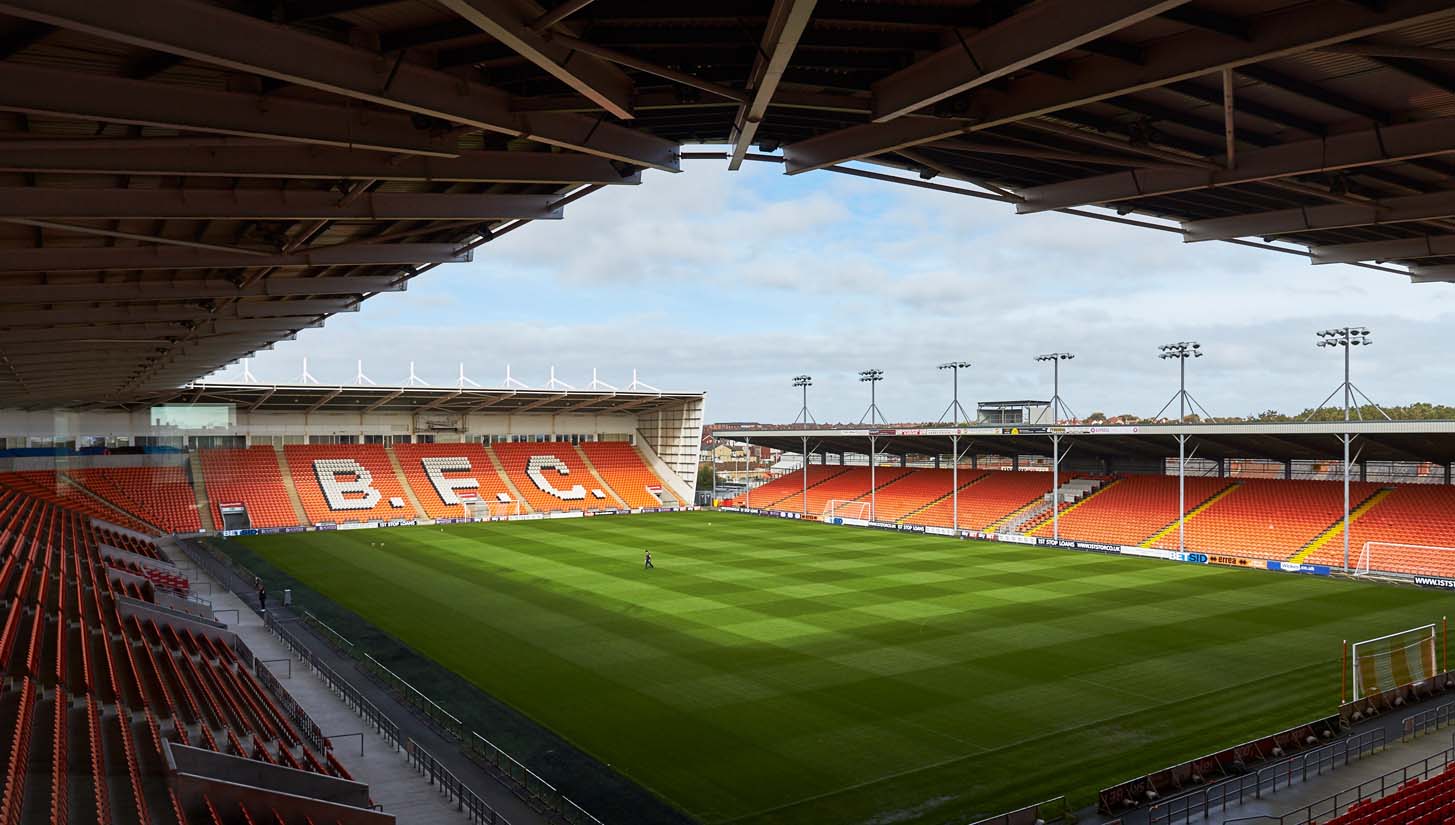
Bloomfield Road is a ground that arrives in pieces. You pick it up through gaps in the terraced streets — a floodlight pylon here, the top of the South Stand there — before the full picture comes together on Seasiders Way. The ground has four distinct stands that feel as though they were each designed by someone who hadn't spoken to the others: the main West Stand runs the length of the pitch with seats at the front and an upper tier above, while the East Stand opposite is a more modest, covered affair. The South Stand behind the goal was rebuilt and has a modern feel that sits slightly oddly against the rest. The North Stand, the Kop end, is where the noise lives when the ground is properly up for it. Floodlights stand on old-fashioned pylons, four corners, casting the right kind of light on a winter evening. The capacity sits just above 17,000 but the place rarely looks full — when it does, though, it feels considerably louder than the numbers suggest.
Away Day Reality
Away supporters are housed in the South Stand, in a section behind the goal with a decent view down the pitch. It's covered, which matters on the Fylde Coast where the wind off the Irish Sea carries with it a kind of damp ambition. The sight lines are reasonable, the facilities functional rather than generous. Home fans tend to be reasonably welcoming to away supporters in the normal run of fixtures — this is a club that has been through enough to keep some perspective — though Lancashire derbies against Preston or Burnley are a different matter entirely. If you get a decent following in, the acoustics in that end are good enough to make a proper racket.
The Walk In
The easiest approach is the Blackpool Tramway, which is itself part of the reason to come. The St Chad's or Manchester Square tram stops put you seven or eight minutes from the ground on foot, and walking to a football match from a Victorian tramway is one of those small pleasures groundhopping delivers that no other hobby comes close to matching. Blackpool South train station is about nine minutes on foot — a straightforward walk down through residential streets. There are also buses that stop right on Bloomfield Road itself, three or four minutes from the turnstiles. Street parking exists in the surrounding roads but fills early. If you're coming from further afield, Blackpool North is the main station and buses from there get you down to the ground without difficulty.
The Arc
The high point came in the early 1950s when Stan Mortensen and Stanley Matthews — the great Blackpool side that reached three FA Cup finals in five years, winning it at last in 1953 in the match the whole country still calls the Matthews Final, though Mortensen scored a hat-trick. That team played in front of 38,000 at Bloomfield Road and genuinely competed at the top of the First Division. What followed was a long, slow descent — through the divisions, through changing ownership, through the years when the Oyston family ran the club and supporters staged prolonged and entirely justified protests that split the town and drained the ground. The return to something like normalcy came painfully slowly. The 2010 Premier League season — yes, one solitary season in the top flight under Ian Holloway, playing football that was genuinely exciting and entirely unsustainable — still burns in the memory. They're in the Championship or League One now, still fighting, still tangerine, still there.
Before and After
The pub situation around Bloomfield Road requires some honest advice: the immediate area is largely residential and options near the ground are limited. Away supporters are better served heading into the town centre before kick-off, where there is no shortage of pubs and bars along the seafront and around the main streets — just be aware that Blackpool town centre on a Saturday is never quiet, and you will be sharing it with people who are there for entirely different reasons. The Promenade is nearby enough to make a walk along the front before the match a genuinely pleasant way to spend an hour. Inside the ground, the pies are solid without being remarkable and the programme is worth picking up for the history alone. When the North Stand gets going — particularly in the lower half of the Championship or League One where the crowd has something to shout about — this is a ground that earns its place in your notebook.
Track every ground you visit
Log your visits, discover new grounds nearby, and see your groundcount grow.
| Download on the App Store | Get it on Google Play |